



Hydrogen-powered cars may be the technological fashion at the moment, but we mustn't forget about all-electric cars either.
Formula E's rapid progress in the last decade or so, from cars slower than a Formula 3 car which couldn't hold enough charge for a race distance, meaning drivers had to swap cars mid-race, to the 'Gen 4', due to be introduced later this year, which the series says will be similar-ish in performance levels to Formula 1, has been meteoric.
But the challenge for battery electric racing cars now isn't necessarily speed. It's longevity and endurance.
And one team is working on that very challenge, with the dream to race their fully electric car at Le Mans in the Garage 56 class in the future.
Resetting the aim
I originally spoke to the team behind InMotion, at the Eindhoven University of Technology in the Netherlands, way back in 2019. Unfortunately the website I wrote that article for no longer exists, but the gist of it was their aim to race at Le Mans in 2023 with a battery electric car, in Garage 56.
Obviously that didn't happen. Instead the Chevrolet Camaro ZL1 NASCAR raced in the experimental or innovative class that year, becoming an immediate fan favourite.
And, before that, team members in 2015 were targeting a 2017 entry to the race, according to an article by Motorsport.com.
So there is a degree of scepticism here. Multiple targets have been continually missed.
 Phil Oakley
But, current team manager Niek van Dam is keen to note the unachievable aims set by InMotion alumni.
Note that because all team members are students, these are different team members than when I spoke to InMotion 7 years ago.
'We've hurt ourselves a bit in the past by setting timelines that were just unrealistic,' said van Dam.
'We're a student team. Every year we switch over, so we're not an official racing team with 20 years of experience in the industry. We really don't want to say 'we'll be there in a couple of years.' It's a dream for us, especially because it's such a cool event, and it really showcases our technology in the harshest conditions.'
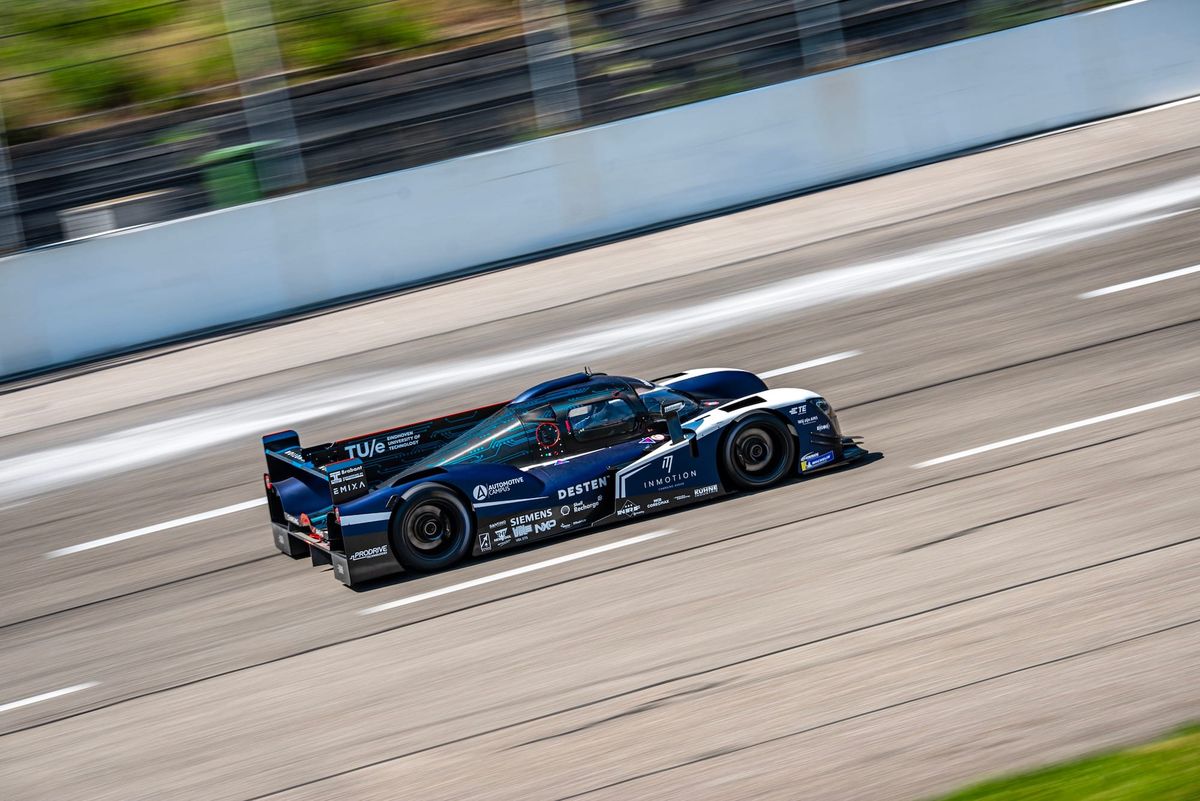
In 2019, the team had recently acquired a Ginetta G58 LMP3 chassis and was equipping it with their battery electric technology, instead of the V8 engine usually inside one of these cars.
Currently, they still have this car, now with the battery and electric motors inside the car. Van Dam explains more:
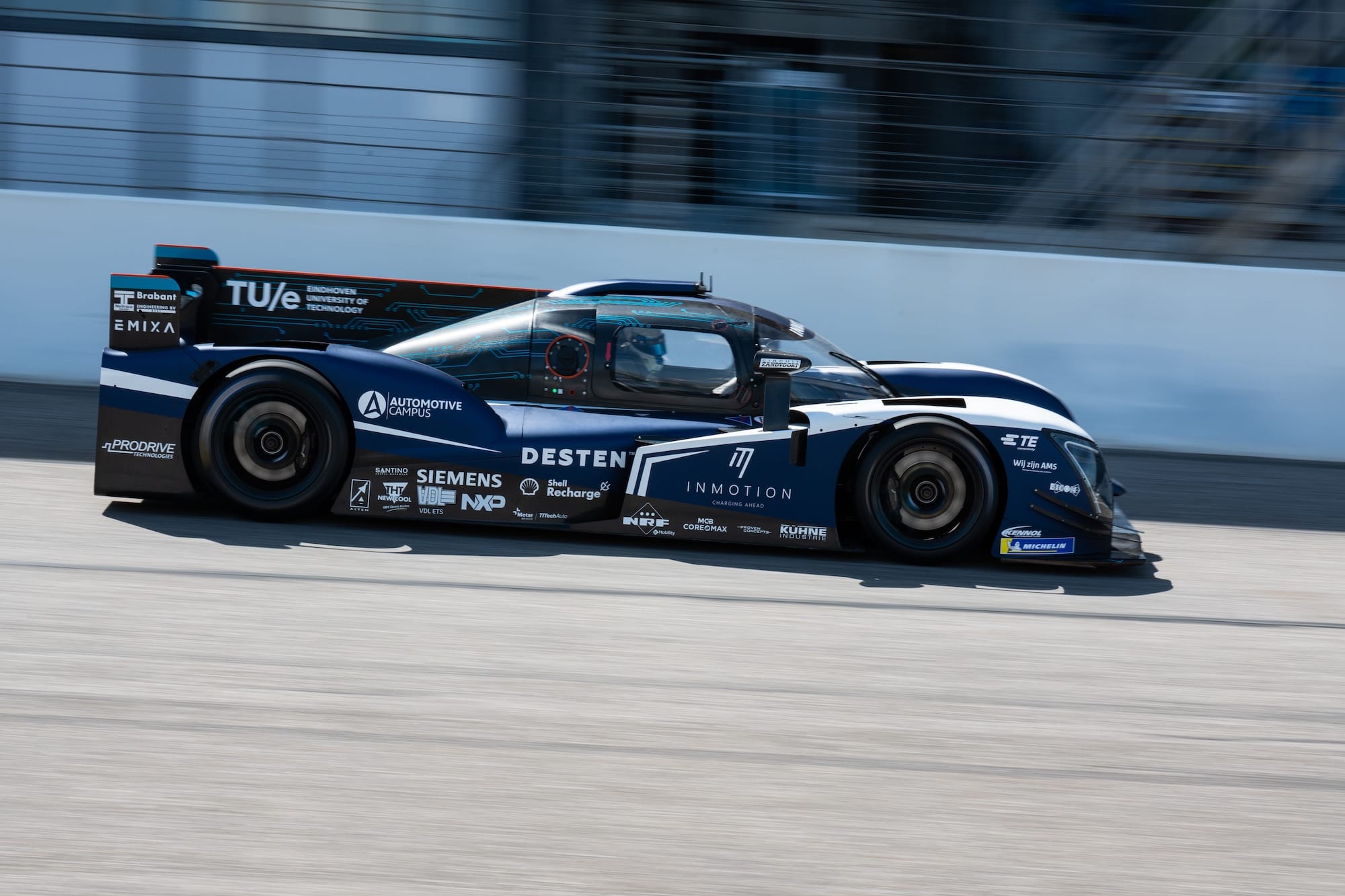
'We worked on our battery pack for three or four years, and now it's in the car. Our car is the Revolution, a Ginetta G58.
'We took the V8 out of it and built the battery pack and the cooling systems into the car. Right now we're driving and testing with this car.
'This year we're building a more reliable and more robust version of the battery pack, because we had some challenges in previous years and we've tried to tackle those and take them into account in the new pack.'
'We were still deciding on our battery cell partner. We've since switched to a different one, Desten. We're currently able to charge in 4 minutes. We're trying to get as close as possible to a regular refuelling time, like you'd do at Le Mans.'
'For racing, Le Mans is our end goal, our dream, but it's still far off. It's 24 hours of endurance racing and we're not quite there yet.
'So our first goal is to drive a one-hour race in the near future, and then afterwards we're going to aim for a four-hour endurance race. That way we gradually build up towards the 24 Hours of Le Mans,' he said.
The InMotion Revolution in action at Zandvoort in the Netherlands. Video: InMotion
1 hour race the aim for now
When I spoke to previous team members in 2019, the aim was charging in 2 minutes for a 10-lap stint at Le Mans, with lap times around the 4:12 mark. For now at least, the charging time aim has dropped to 4 minutes, double the original goal.
A regular Le Mans pitstop is around a minute and a half for a 'full service ', driver, tyres and fuel, so even 2 minutes is a substantial increase on that, let alone 4, well over double.
For context, the current Hypercars lap the track in the race at around the 3:26 mark. The LMP2s are around 13-14 seconds slower than that on average, while the LMGT3s are a further 20 seconds off.
So compared to their competition, even if they were running to GT3 pace, as is the aim, they'd lose more than 2 minutes in the pits every stop. At Le Mans that's a bit more than half a lap. At a track like Zandvoort, they'd lose well over a lap.
With Le Mans being re-targeted as a dream for now, Van Dam didn't disclose current lap time targets for the French endurance classic, or stint length.
This one hour race will be in the Supercar Challenge series, which has a range of classes within it and races twice a year at Circuit Zandvoort, roughly two hours from Eindhoven.
'We're aiming to enter the Supercar Challenge,' said van Dam.
'It doesn't have many regulations, which makes it easier for us to take part. They do have different classes, and the closest one to us is something like GT3, but we don't really fit into any existing class.
'They're looking at how to make it work safely, and they're trying to get to the point where they let us race, rather than just slotting us into a category that doesn't really fit. It'll end up being something similar to Garage 56 at Le Mans in that sense. We're aiming to have GT3-level race pace.'
 Phil Oakley
The tech
So, how are the InMotion team achieving those 4 minute recharging times?
I'll let van Dam explain.
'The battery pack consists of eight modules, and each module has 48 cells. We don't make the cells ourselves; we get them from our partner. What we do is cool in between each individual cell: we add a cooling layer, and because of the large surface area, the heat comes out very quickly. That's how we cool it.
'Each module runs at 200 volts. The cells themselves are 4.2 volts each. We combine two strings of four modules, which is why the battery runs at 800 volts in total.'
'One module is around 36 kilograms. The whole car, everything included, comes to around 1,300 kilograms, which is significant. It adds a lot of load to the back of the car, because the monocoque is at the front and the battery is at the back, that makes the car more difficult to drive.'
A Ginetta G58 usually weighs around 900kg, so 400kg extra is a significant, considerable amount to add on to the car.
Regarding power levels, the team says the two electric motors, one on each rear wheel, can deliver peak power of 324kW to the rear wheels, while the battery pack is 800 volts. This gives a top speed of around 320kph (just under 199mph).
However, during that one-hour Supercar Challenge race, the car would have to stop twice to recharge, at 4 minutes each, or maybe even three times.
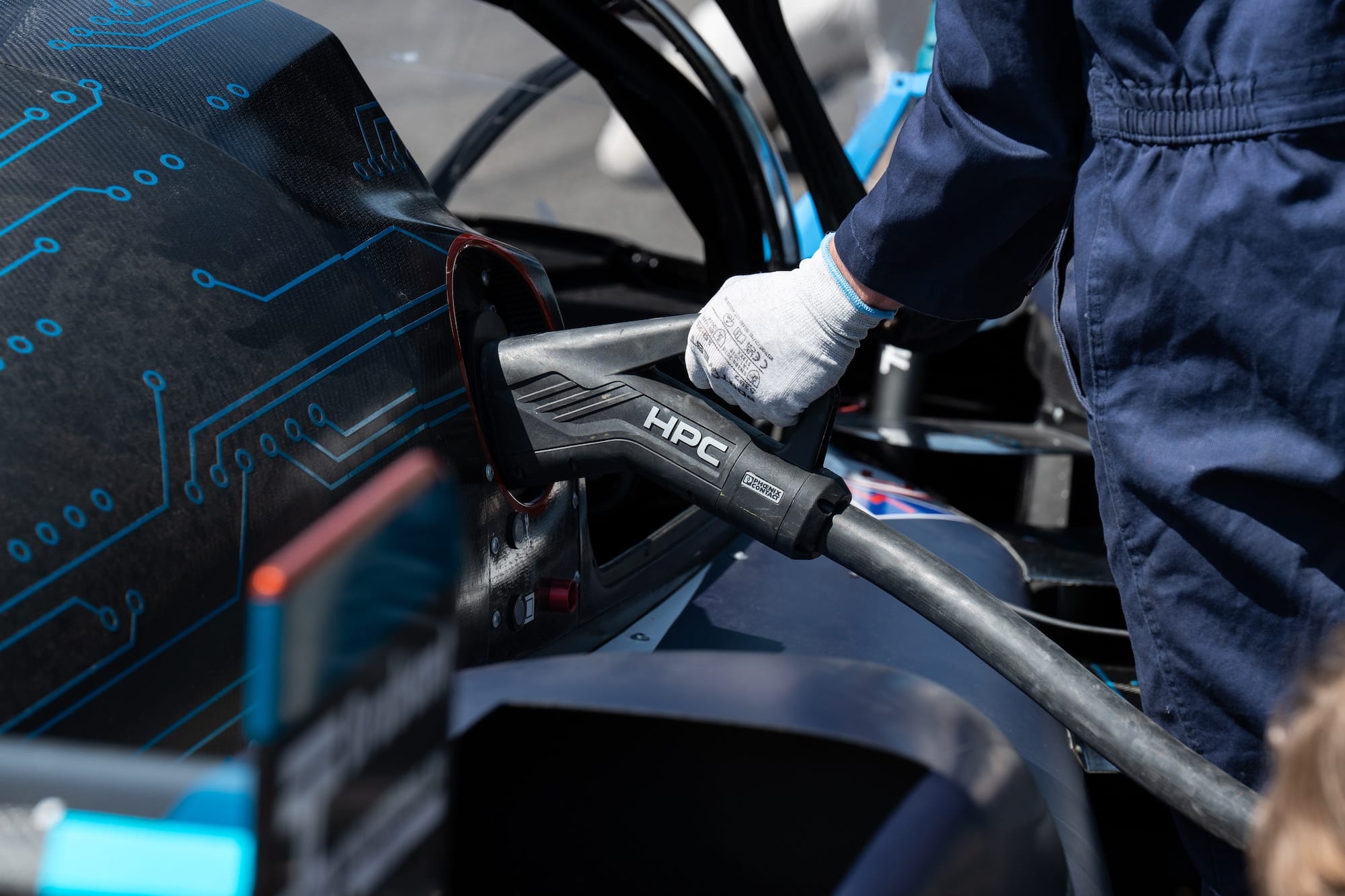
'Every four minutes, yes,' said Van Dam when I asked how long a stop would take during the one-hour race.
'It's quite something to hear from the simulations. We catch up to everybody during the actual driving time, then we go into the pits and lose that back. The other cars in the series have a rule that they have to pit at least once too, so compared to them we effectively have one extra stop to make up time on elsewhere.'
The challenges of racing
Ahead of the Supercar Challenge race in what van Dam termed as 'the near future', unwilling to put a date on it and not set expectations, he told me there are multiple hurdles to overcome first.
'Both endurance-based and performance-based challenges, really, from both perspectives,' he said.
'On the performance side, the regular fuel cars we'll be racing against aren't electric, so they can drive an hour without having to refuel. With our current capacity, we'd have to charge maybe two or even three times in an hour, so we'd have relatively more downtime than them. That's really our biggest hurdle performance-wise. On track itself, we can drive the same speeds, if not faster, than our competitors in that race.'
'For endurance, we're really noticing two main things: the reliability of the battery pack, which we hope to have resolved with the second iteration, and the system integration and embedded software.
'There's so much software involved, and our error handling is such a tricky component. We hope to have these challenges dealt with by the end of the year, but we really don't know exactly when the race itself will happen.'
 Phil Oakley
This second battery pack iteration, replacing the one currently in the back of the Ginetta G58, has been designed to fix the problems with the first iteration InMotion built with their battery partners, Desten.
Van Dam told me the new pack would be 'more robust.' I asked him to explain what that means.
'Partly mechanical,' he said.
'It's also about testing and understanding more. The error-handling and software challenges we're facing for the one-hour race are still things we're working through, and we've never driven longer than 20 to 30 minutes continuously, so we don't really know what to expect over four hours.
'We don't know, for instance, whether temperatures gradually build up over that time and start affecting performance. There's still a lot unknown. We hope that once the next battery pack, which we're building right now, is in the car, we'll get more clarity on what's ahead.'
The InMotion Revolution in action at Circuit Zolder. Video: InMotion
The realities of a student team
InMotion is a purely student team, with the members working on the project alongside the studies. Van Dam, for instance, is studying for an MSc in Operations Management & Logistics.
This means the team will rotate again in September when a new cohort of students starts work on the InMotion project.
'Every year we start in September with a completely new team,' said Van Dam.
'We run full transfer weeks, two of them, plus handover days, where new team members work alongside the outgoing team to absorb their knowledge. At the start of every year, you notice the team ending has a lot of knowledge, and the new one doesn't yet.
'What we do is keep a big alumni network of former team members, and they come back, every Wednesday, for example, to give advice and pass on their knowledge to the new team.
'That way we try to keep the knowledge within the team and keep growing, instead of starting from zero every year. There's also a lot of documentation. Big decisions and engineering choices are all written down.'
'But you do notice there's an exponential growth in efficiency and development pace throughout the year, as the new team gets further into it. That's also part of the beauty of it, though. You're teaching a group of 25 students not just how to build and run a car, but how to actually apply what they've learned during their studies, in reality.'
When I spoke to the team in June, they were almost 10 months in, so they're now 11 months into the project, well into the knowledge transfer process for the incoming team.
'We're really busy trying to hit our goals before the end of the term. We've already started transferring knowledge to the incoming team.'
My final question was on how this process works. Getting deeply into an exciting project, but having to stop working actively on it after a year.
'Honestly, it's bittersweet,' said van Dam.
'But you know it's coming, and every team goes through it, so you're aware of it going in. There are also alumni groups you can join, so you stay in contact and stay informed about the project, just not as deeply involved as before.'
While the project is, at least in my mind, genuinely interesting, multiple deadlines have been missed in the past. Put this together with the current team unwilling to put a date on when they'll race in Supercar Challenge, I am somewhat uncertain of whether InMotion will reach Le Mans. Especially since currently the Ginetta-based Revolution hasn't run for more than 20 or 30 minutes continuously.
But, the world's premier 24 hour race was founded on the premise of technological development, and while that may be less of a focus for the established manufacturers and cars today, it's still an important part of the race's history and future. And an all-electric prototype would fit right in there. Let's hope it happens.